Rahu and Ketu in Vedic Astrology: Meaning and Effects
Rahu and Ketu in Vedic astrology, their effects on career, relationships, personality, and all 12 houses of your birth chart.
Author - Astromee Editor
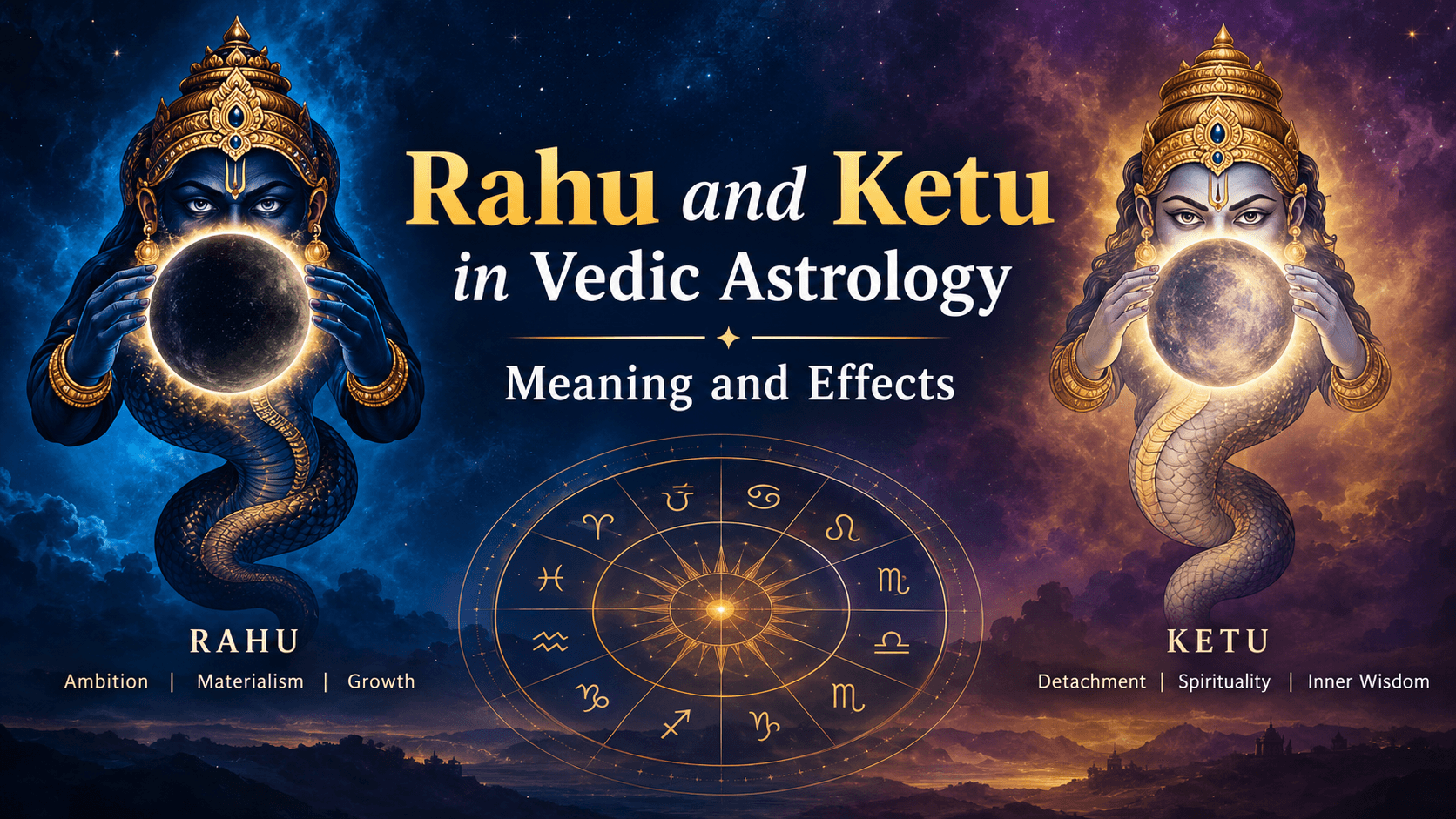
Do you sometimes wonder why some phases of life suddenly turn out to be successful or full of unexpected transformations and make one long to renounce the world for seeking spiritual enlightenment?
In Vedic astrology, Rahu and Ketu are two grahas which depict two entirely different attitudes. The attitude of materialism, ambition, and desire is determined by Rahu in a person’s horoscope whereas Ketu denotes the attitude of detachment and positive thinking while being in isolation and meditating deeply to gain spiritual wisdom.
- But what exactly are Rahu and Ketu?
- What is their significance in your horoscope, and
- What influence can the shadow planets have on your professional life, on your relations, on your character, and on your important life choices?
Let’s explore further the meanings of Rahu and Ketu and their individual effects, plus how they play a significant role in your birth chart.
See: Astronomy vs Astrology: scientific and cultural traditional belief system
What Are Rahu and Ketu in Vedic Astrology?
In Vedic astrology, some of these phenomena are explained by the effects of Rahu and Ketu. While other planets, including Mars and Saturn, are physical entities, Rahu and Ketu are simply mathematical points in the sky known as the lunar nodes. However, they play a significant role in Vedic astrology.
Vedic astrology calls Rahu and Ketu the “shadow planets” or “chhaya grahas” because they are two mathematical points created in the sky and have been given mahadasha periods, house-by-house effects, and other karmic significance on par with the other planets. They are 180° degrees apart from each other in the sky, and while Rahu is in any given sign and house, Ketu is in the exact opposite sign and house of that Rahu placement.
Because of this, Rahu and Ketu form the karmic axis similar to that of Saturn and Uranus in Western astrology.
In Vedic astrology, North Node is called Rahu, which is the head of the celestial dragon demon while South Node is called Ketu, which is considered the body of the celestial dragon demon.
Rahu in Astrology
Rahu represents the boundless aspirations of human beings to achieve more in life. It manifests in a person’s keen desire to explore unknown lands, discover new experiences, and to attain greater material success. A person always desires recognition of his endeavors in life.
Rahu is often associated with
- Technology,
- Foreign connections,
- Unconventional ideas, and
- The desire to stand out from others.
He is not always negative. His interpretation can vary from very positive to very negative depending upon various factors such as his place in the chart, sign lord’s condition in the chart, other planets in the chart etc. etc.
Traditional associations of Rahu include:
- Ambition and the desire for success
- Material goals and recognition
- Curiosity and unconventional thinking
- Foreign cultures and unfamiliar experiences
- Excessive attachment or confusion in challenging interpretations
Rahu reveals a desire and a drive to reach our goals, to achieve more. Rahu represents our utmost desires, goals, and drives. However, it can also have a negative side, and that depends on the rest of the chart.
Read Also: Items Not To Be Gifted As Per Vastu Shastra on Bhai Dooj 2026
Ketu in Astrology
The planet Ketu symbolizes detachment and its connection to spirituality and questing for the truth from within. There is the desire to learn and link with the higher self. The planet Ketu is opposite to the Rahu (body instincts). While the Rahu symbolizes answers to materialistic expressions, the Ketu symbolizes questions to materialistic expressions.
According to some views of the Vedic astrology, Ketu has been associated with past life karma. This is solely a spiritual concept and not at all a scientific fact.
Traditional associations of Ketu include:
- Spiritual growth and self-reflection
- Detachment from material desires
- Intuition and inner exploration
- Interest in meditation and spiritual practices
- Separation, uncertainty, or dissatisfaction in some interpretations
Note: Ketu is not always bad and needs to be viewed in the positive light as an opportunity to grow, learn and move in a different direction than what you are used to.
Also Read- Role of Vedic Astrology in Indian Marriages
How Rahu and Ketu Affect Your Life
Rahu and Ketu are evaluated using information gathered from their positions in a birth chart as well as their placement in the houses of that chart. They are evaluated while in specific zodiac signs and in different planetary periods.
1. Career
Rahu represents the ambition of a person, helping him to excel in his field of work, and also the innovative ideas he brings to apply in life to achieve success and recognition in his career.
2. Relationships and Marriage
The traditional approach to Rahu is of desire and attraction in unusual forms. Ketu is seen from a perspective of detachment. As with any planetary study, the 7th house and other planets are also considered while forming an opinion of a person’s relationships and marriage.
3. Personality
As the head of the dragon ascends upwards in search of more and more, Rahu symbolizes an innate curiosity in human nature for more knowledge. On the other hand, Ketu, as the tail of the descending serpent, brings about a deep introspection into our lives for higher knowledge and spiritual growth.
See: Kundli Milan for Marriage in 2026: Gun Milan Complete Guidance
Rahu and Ketu in the 12 Houses of the Birth Chart
The 12 houses represent various aspects of the life of a person. Both Rahu and Ketu are placed in opposite houses of a Kundli. The astrologer studies both the planets together while interpreting their effects.
| House | Traditional themes associated with Rahu | Traditional themes associated with Ketu |
| 1st / 7th | Identity, ambition, and self-expression | Relationships, independence, and detachment |
| 2nd / 8th | Wealth, speech, and family values | Shared resources, change, and deeper inquiry |
| 3rd / 9th | Communication, courage, and initiative | Beliefs, higher learning, and spiritual questions |
| 4th / 10th | Home, emotional security, and private life | Career, public responsibilities, and purpose |
| 5th / 11th | Creativity, recognition, and personal ambitions | Friendships, social groups, and gains |
| 6th / 12th | Competition, service, and daily responsibilities | Solitude, spiritual practices, and letting go |
Note: Although opposite houses are given in the above table for ease of reference, Rahu and Ketu do not produce similar results in each chart. Other factors such as the sign placed in the house lord, combinations with other planets, and the planet in whose dasha the event takes place also play a significant role in interpreting results of Rahu-Ketu.
Check It: Palm Reading Marriage Line That Interpret Divorce and Separation
Conclusion
Vedic astrology represents the ambitions in life and relationships of an individual through Rahu and Ketu, two shadow planets.
Rahu can symbolize great ambition, much material success, and even lots of experience of life and new things. Ketu can represent detachment from all these things and give the person a very introspective nature and great inner wisdom.
Rahu and Ketu placed in the 12 houses of a horoscope, in different signs, and influencing different periods of life of an individual in Mahadasha of Rahu or Ketu, as the case may be, have their own significance.
Together, the Rahu–Ketu axis brings to our attention the great struggle between worldly ambitions and spiritual aspirations.
Vedic Astrology gives us more insight into the role that Rahu and Ketu play in a person’s life by analyzing their behavior and impact on a person’s career, relationships, personality, and overall growth.
See: Moolank 1 to 9: Personality, Career & Love Compatibility
Recent Blogs
Rahu and Ketu in Vedic Astrology: Meaning and Effects
Moolank 1 to 9: Personality, Career & Love Compatibility
Mangal Dosha in Astrology: Meaning, Effects & Remedies
Vedic Astrology vs Western Astrology: 7 Key Differences You Should Know
Lal Kitab Astrology: Meaning, History, Remedies & Predictions
Navratri 2026: 9 Forms of Maa Durga and Their Astrological Significance