Navratri 2026: 9 Forms of Maa Durga and Their Astrological Significance
Explore the 9 forms of Maa Durga, their names, significance, spiritual meanings, and connection with Navagraha in Vedic astrology.
Author - Anuradha
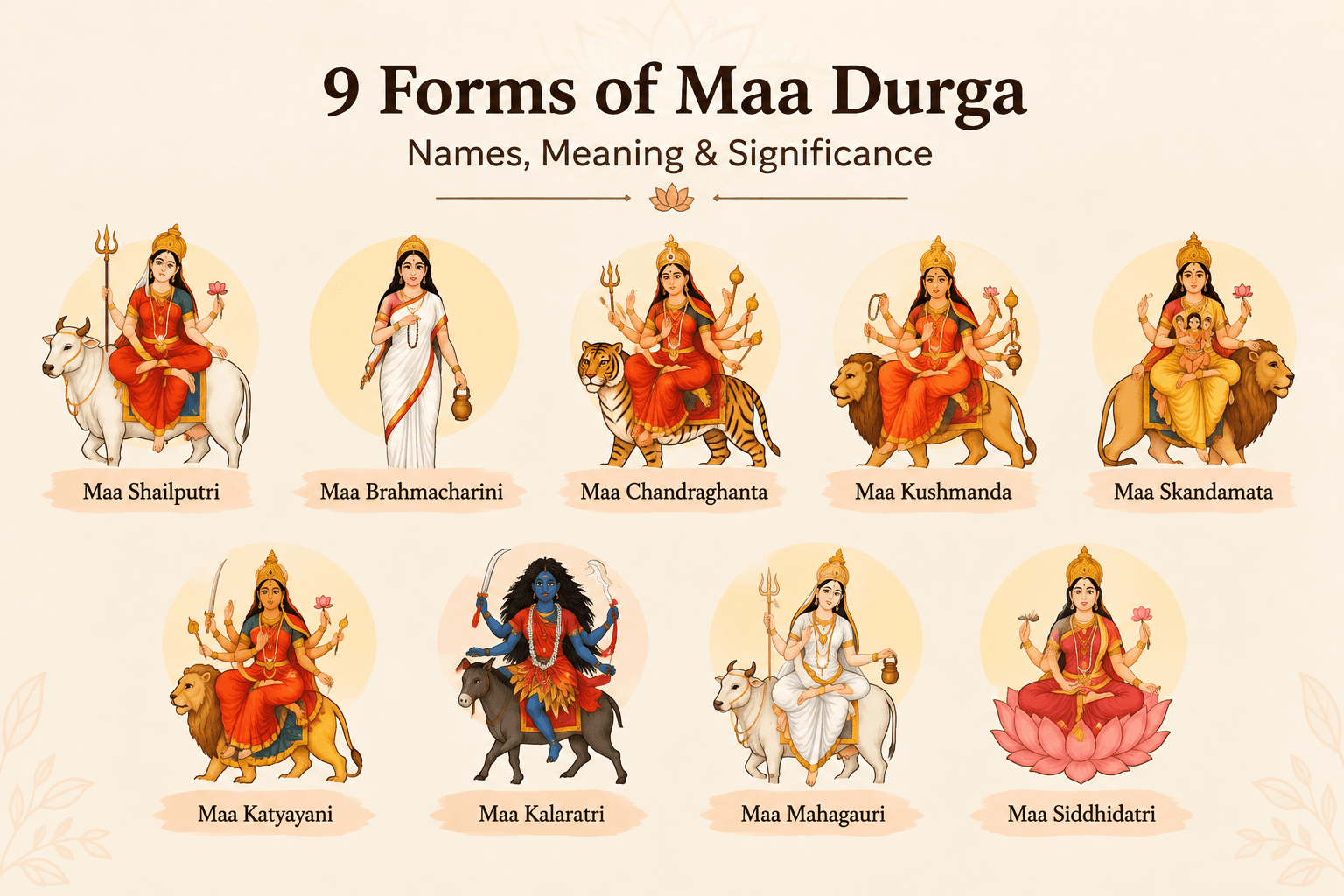
Navratri is one of the most celebrated festivals of sanatany’s , dedicated to Maa Durga and her nine forms, all the forms of Durga collectively is known as Navdurga and the celebrations goes for nine days continuously. Each day is associated with different form of Goddess- representing Shakti, Strenght, wisdom , courage ,and spiritual growth.
Nine days can be seen as positive and spiritual transformation of individual and can be symbolically viewed with the energies of nine planet.These nine days can be seen with the astrological prespective helping devotees to reflect different arenas of their life.
Devotees use these days not only for worshipping Maa Durga by can take opportunity to inculcate strength , overcome negativity and set positive pavement for the times to come ahead in life.
Read Also: Moolank 3: Jupiter Connection, Personality, Career & Compatibility
What is Navratri?
The word Navratri comes from two Sanskrit words—Nav mean nine days and Ratri mean night, altogether it makes Nine Nights for celebrating Maa durga’s different forms.
Navratri is celebrated four times during the year, but Chaitra Navratri and Sharad Navratri are the most popularly celebrated. Sharad Navratri, is generally falls around September–October, is especially for the worship of Maa Durga.
The nine days are dedicated to the nine forms of the Goddess:
1. Maa Shailputri
2. Maa Brahmacharini
3. Maa Chandraghanta
4. Maa Kushmanda
5. Maa Skandamata
6. Maa Katyayani
7. Maa Kalaratri
8. Maa Mahagauri
9. Maa Siddhidatri
Each form carries a unique spiritual message and has different attire with different weapons.
The 9 Forms of Maa Durga and Their Significance
Day 1 of Navratri – Maa Shailputri: Strength and Stability
Maa Shailputri is worshipped on the first day of Navratri. She is known as the daughter of the Himalayas and is traditionally depicted riding a bull, holding a trishul and lotus.(Flower of Kamal).
She represents stability, strength, determination and grounding.
The first day reminds us that every new beginning requires a strong foundation. The basic planning and ground has to be strong to build strong future.
Astrological significance Of Navratri’s first day.
If we talk about connection of this with astrology, stability and discipline are important aspects associated with Saturn, while the Moon represents emotional grounding and mental stability.
Rather than assigning Maa Shailputri exclusively to one planet, devotees can use this day as an opportunity to reflect on Saturn- and Moon-related themes in their lives:
- Am I emotionally balanced? Do I take things calmly and in a mature way.
- Am I disciplined enough to achieve my goals? Discipline is important ingredient of successful life.
- Do I have a stable foundation in my personal and professional life? Again stability has to be aligned with discipline.
- Where do I need greater patience? Moon calmness and Saturn discipline in life to balance the emotion quotient of one individual.
Spiritual practice
On this day, focus is on keeping your self humble and grounded. Pray to inculcate stability, patience and strength to begin something meaningful and concrete in life.And first day of Navratri teaches us this and astrologically aligns our emotional aspect with discipline.
Maa Shailputri rides Nandi, the sacred bull, symbol of strength and carries a Trishul (trident) and a lotus in her hands. She symbolizes strength, purity, devotion, and determination to get the things done in positive way.
See: Kundli Milan for Marriage in 2026: Gun Milan Complete Guidance
Day 2 Of Navratri – Maa Brahmacharini: Teaches us Discipline and Spiritual Growth
The second day of Navratri is dedicated to Maa Brahmacharini. She represents austerity, devotion, determination and spiritual discipline.
She teaches us meaningful achievements often require patience and consistent effort.The persistent efforts are the key to success.
Astrological significance of Navratri’s Second Day.
This day can be associated symbolically with major represented by Jupiter and Saturn—knowledge, discipline, patience and long-term growth. Again Saturn aspect of discipline is prominent.
It is an excellent day to reflect on:
- Education
- Career goals
- Spiritual development
- Self-control
- Long-term plans
If you are unable to concentrate on meaningful completion of work then worshipping this day to Maa Durga will help.
Spiritual practice
Utilise this day for prayer or meditation. Instead of asking only for immediate results, pray for the discipline and wisdom required to achieve your goals.
Maa Brahmacharini is worshipped on the second day of Navratri. She walks barefoot, symbolizing penance, make people repent for what they have done wrong and not to continue that, simplicity, and dedication, and carries a Japmala (rosary) and Kamandalu (water pot). She represents devotion, patience, self-discipline, and spiritual wisdom, teaching devotees that determination and faith help them overcome life's challenges.Life challenges are the part of life , challenges do come but get resoved also.
Day 3 of Navratri – Maa Chandraghanta: Courage and Emotional Balance
Maa Chandraghanta is worshipped on the third day of Navratri. Third day name of Maa is derived from the crescent moon shaped (half moon) like a bell on her forehead.
She represents courage, peace and protection.
Her form beautifully combines strength with calmness. Where an individual has the strength but is grounded.
Astrological significance of third day of Navratri.
The Moon plays an important role in Vedic astrology because it represents the mind, emotions, intuition and inner peace.
Emotional reflection depicts third day. Moon dominated symptoms.
Ask yourself:
- Am I allowing emotions to control my decisions? We should control emotions, not the vice versa.
- Am I carrying unnecessary fear? Which is fear of unknow, that shows negativity and emotionally weak thought process.
- Do I need greater emotional balance? Strength of emotions.
- How can I respond rather than react? Reaction to every action is not required and can be controlled.
Spiritual practice on the Third day of Navratri.
Prayer and meditation can be particularly helpful on this day. On this day peaceful mind leads to strong emotional person who can face challenges with great courage.
Maa Chandraghanta is worshipped on the third day of Navratri. She rides a tiger or lion, and carries divine weapons such as the Trishul, Gada, bow, arrow, sword, and bell, along with a lotus. She symbolizes courage, fearlessness, alertness, and the power to destroy evil. Her fierce yet compassionate form inspires devotees to face difficulties boldly while maintaining inner peace. Calmness when combines with boldness , it fetches result which is acceptable by one self with happiness.
Check It: Palm Reading Marriage Line That Interpret Divorce and Separation
Day 4 Of Navratri. – Maa Kushmanda: Creativity, Energy and Abundance and Expansion.
The fourth day is dedicated to Maa Kushmanda.
Maa Kushmanda is inspiration of the cosmic creative energy and is considered a source of vitality and abundance. Idea behind her name is egg – Bramand.
Astrological significance of the fourth day of Navratri
This form of Maa ‘s strength is associated with solar energy—vitality, confidence, creativity, leadership and life force.
The Sun in astrology represents:
- Confidence
- Authority
- Leadership
- Vitality
- Self-expression
- Recognition
This day marked for an excellent time to reflect on your confidence and leadership abilities, with showcasing of your leadership qualities to world.
Spiritual practice
You can reconnect with your self , if any doubts is pulling you back.
Do not ask your self that what is the lacuna in myself, instead of this ask what are my strengths and how I can utilise them to bring prosperity and happiness in my life.
Maa Kushmanda is worshipped on the fourth day of Navratri and is believed in Hindu tradition to have created the universe through her divine smile, bringing light into the cosmic darkness, taking Universe ahead from darkness to light as a whole.. She rides a lion and is traditionally depicted with eight hands carrying a Chakra, Gada, bow, arrow, sword, Kamandalu, Japmala, and Amrit Kalash. She represents creation, vitality, radiance, health, and prosperity, reminding devotees of the creative power and positive energy that can transform darkness into light.
Day 5 – Maa Skandamata:
Motherhood, Compassion and Protection, the way Mother protects children this day marks the protection of mother.
Maa Skandamata is worshipped on the fifth day. She is depicted carrying her son Kartikeya, also known as Skanda.
Maa Skandamata represents motherly love, compassion, protection and nurturing energy.
Astrological significance of the fifth day of Navratri.
The Moon is mainly associated with nurturing, emotional security and motherhood.
This day can therefore be used for reflecting on relationships:
- Family relationships
- Emotional security
- Caring for others
- Forgiveness
- Compassion
A beautiful day to express gratitude toward your parents, family members, teachers or anyone who has supported you. Parents are those stairs with you climbs and get settled life with success and happiness throughout the life span. Relatives are your circle for nurturing your habits of brotherhood.
Spiritual practice
This day marks the thankfulness without expecting returns. But focus is on work , hardwork.
Sometimes the simplest form of devotion is compassion.
Maa Skandamata is worshipped on the fifth day of Navratri. She rides a lion, holds lotus flowers in her hands, and carries her son, Lord Skanda (Kartikeya), in her lap. She symbolizes motherhood, unconditional love, when a person knows everything about you , but still protects and love you, that can be Maa only., compassion, courage, and protection. Her divine form represents the strength of a mother who nurtures her children while possessing the courage to protect them from every adversity.She depicts , bold strong mother who protects her children in any phase of life.
See: Dasha in Vedic Astrology: Meaning, Mahadasha, Antardasha & Effects
Day 6 of Navratri– Maa Katyayani: Courage, Determination and Victory, “Dharm ki Adharm par vijay”
The sixth day is dedicated to Maa Katyayani.
Maa Katyayani is powerful warrior form of Maa Durga and represents courage, determination and the destruction of negative forces, the destroyer of adharma and adharmi.
Maa Katyayani is also traditionally associated with prayers for successful marriage and marital harmony.
Astrological significance
This day is dominated by qualities which donates Mars—courage, action, determination and the ability to confront challenges.
Mars , mangal represents:
- Energy
- Courage
- Competition
- Action
- Determination
- Assertiveness
On this day you may take decision of taking difficult task in hand, this is a powerful day to reflect on what needs to be confronted.
Spiritual practice for this sixth day :
Pray for courage not just for the problems to disappear, but for the strength to face them.Courage to take challenge and beat the problems.
inspires devotees to stand up against injustice, overcome fear, and pursue truth with confidence and conviction.
Maa Katyayani is worshipped on the sixth day of Navratri. Depicted as a powerful warrior goddess riding a lion, she carries a sword and a lotus in her hands in many traditional representations. She symbolizes bravery, justice, determination, and the triumph of good over evil. Her divine strength inspires devotees to stand up against injustice, overcome fear, and pursue truth with confidence and conviction. Maa Katyayani depicts bravery with justice.
Day 7 – Maa Kalaratri: Destruction of Negativity
Maa Kalaratri is worshipped on the seventh day.
Her fierce appearance represents the destruction of fear, darkness, negativity and ignorance. Taking an individual to positivity , from darkness to light.
Astrological significance
Her appearance is very frightening , but Goddess of courage is reflected in her fierce face also, you love to gaze her as son and daughter.
This day can be connected symbolically with transformative planetary energies, particularly themes associated with Rahu, Ketu and Saturn.
These planets are often associated in astrology with lessons involving:
- Detachment – Ketu, taking you towards Moksha.
- Transformation
- Fear
- Uncertainty
- Karma
- Hidden challenges
The deeper message is not to fear difficult planetary periods but to use them for growth and self-awareness.
Spiritual practice
This is an ideal day to identify what you want to release:
- Negative habits
- Unhealthy attachments
- Fear
- Anger
- Resentment
- Self-doubt
This day marks letting go the mantra of the day for success and happiness.
Maa Kalaratri is worshipped on the seventh day of Navratri. She rides a donkey and is traditionally depicted carrying a sword and a Vajra (thunderbolt), with one hand offering blessings and another providing protection. She symbolizes fearlessness, the destruction of negativity, protection from evil, and the power to overcome darkness. Although her appearance is fierce, she is considered benevolent toward her devotees and teaches them to confront their deepest fears with faith and courage. Apperance of Maa is very scary , but the devotees feel eternal happiness and love and protection from Maa.
Read This: Shani Dev in Vedic Astrology: Career, Sade Sati & Saturn Remedies
Day 8 – Maa Mahagauri: Purity, Peace and Renewal
The eighth day is dedicated to Maa Mahagauri.
Maa represents purity, peace, serenity and renewal.
As Navratri moves toward its conclusion and meaningful completion , the energy shifts from confronting darkness to finding peace and clarity. Going towards light and salvation.
Astrological significance
Maa Mahagauri can be looked through the qualities of Venus and the Moon—peace, beauty, harmony, emotional balance and refinement.
This is an excellent day to focus on:
- Relationships
- Peace at home
- Emotional healing
- Self-care
- Harmony
- Forgiveness
Spiritual practice
Avoiding confrontations and avoid fight and going for peace as another form of strength
Maa Mahagauri is worshipped on the eighth day of Navratri, known as Ashtami. Many people offer prasad to girls along with some gifts and worship them like maa.She rides a white bull and is often depicted carrying a Trishul and a Damru. Her radiant white appearance symbolizes purity, peace, forgiveness, serenity, and spiritual renewal. She is symbol of removing past hurdles and negativity and bring in divine grace.
Day 9 – Maa Siddhidatri: Wisdom, Fulfilment and Spiritual Completion
The ninth and final form is Maa Siddhidatri.
She is associated with wisdom, spiritual accomplishment and fulfilment.
The word Siddhi refers to accomplishment or spiritual attainment , meaningfull completion.
The final day represents the amulgification of the journey through the nine forms of Shakti.
Astrological significance
This day can be through Jupiter and Ketu-like themes—wisdom, spirituality, higher knowledge, detachment and inner realization.
It encourages us to look beyond material achievements to what gives meaning to your life.
Spiritual practice
On the final day, express gratitude for everything you have learned and experienced.BE kind and humble to all around you as an individual.
Instead of only asking for more, take time to thank the Divine for what you already have.Gratitude is the essence of this day.
and represents the culmination of the Navratri journey, guiding worshippers toward wisdom, inner balance, and spiritual fulfillment.
Maa Siddhidatri is worshipped on the ninth day of Navratri, known as Navami. Many people celebrate this day as “ Navami” and call small girls at home and worship them like maa , wash their feet offer them food with gifts. She is often depicted seated on a lotus or riding a lion and carries a Gada, Chakra, Shankha, and lotus in her four hands. She symbolizes spiritual accomplishment, divine wisdom, perfection, and the fulfilment of sincere aspirations. She is believed to give her devotees some special siddhis and represents the culmination of the Navratri journey, guiding worshippers toward wisdom, inner balance, and spiritual fulfilment.
Check This: Palm Reader Calculator
The 9 Forms of Maa Durga and the 9 Planetary Energies
During spiritual and astrological interpretations, the nine forms of Maa Durga are sometimes connected symbolically with the Navagraha, or nine planetary influences.
However, these associations can vary across traditions. They should therefore be understood as symbolic spiritual correspondences rather than universally fixed astrological rules.
The nine planets traditionally considered in Vedic astrology are:
- Sun – Surya
- Moon – Chandra
- Mars – Mangal
- Mercury – Budha
- Jupiter – Guru
- Venus – Shukra
- Saturn – Shani
- Rahu
- Ketu
The deeper lesson is that Navratri is to work consciously with different qualities in our lives—confidence, emotions, courage, communication, wisdom, relationships, discipline and transformation.
FAQs: 9 Forms of Maa Durga and Their Astrological Significance
1. What are the nine days of Maa Durga?
Ans. The nine days are Maa Shailputri, Brahmacharini, Chandraghanta, Kushmanda, Skandamata, Katyayani, Kalaratri, Mahagauri, and Siddhidatri.
2. What is the significance of the nine days of Navratri?
Ans. The nine days symbolize devotion, spiritual growth, inner strength, courage, and the victory of good over evil.
3. Which goddess is worshipped on the first day of Navratri?
Ans. Maa Shailputri is worshipped on the first day.
5. Which form of Maa Durga represents courage and fearlessness?
Ans. Maa Chandraghanta and Maa Katyayani are associated with courage, bravery, and protection.
6. What is the significance of Maa Kalaratri?
Ans. Maa Kalaratri represents fearlessness and the destruction of negativity, darkness, and ignorance.
7. What is the significance of Maa Siddhidatri?
Ans. Maa Siddhidatri represents wisdom, spiritual accomplishment, and fulfilment.
8. How are the nine forms of Maa Durga connected to the Navagraha?
Ans. They are sometimes linked symbolically to the nine planetary influences in Vedic astrology, although these associations vary across traditions.
Recent Blogs
Navratri 2026: 9 Forms of Maa Durga and Their Astrological Significance
Dasha in Vedic Astrology: Meaning, Mahadasha, Antardasha & Effects
Shani Dev in Vedic Astrology: Career, Sade Sati & Saturn Remedies
Moolank 3: Jupiter Connection, Personality, Career & Compatibility
Kundli Milan for Marriage in 2026: Gun Milan Complete Guidance
Palm Reading Marriage Line That Interpret Divorce and Separation